
California vs. the IRS: Why Your Federal Return Isn't Your California Return (Part 1)
The trap
Every year, we see the same thing happen to smart, careful people: they read a tax headline — "Congress passes bigger deduction for X" — assume it applies everywhere, and plan around it. Then their California return comes back and the number doesn't move the way they expected.
It's not an error. It's conformity — or, in California's case, the lack of it.
What "conformity" actually means
States don't write their own tax code from scratch. Most start with the federal Internal Revenue Code and either adopt it automatically as it changes ("rolling conformity") or freeze it as of a specific date and update that date periodically ("fixed-date conformity"). California does the latter — and does it selectively, meaning even after it moves the date forward, it can still carve out specific federal provisions it doesn't want.
That combination — a fixed date and selective carve-outs — is why California diverges from federal law more than almost any other state.
The big update: California just moved its conformity date

For over a decade, California's conformity date was frozen at January 1, 2015. Anything Congress changed federally after that — the 2017 Tax Cuts and Jobs Act, COVID-era relief, and everything since — simply didn't exist for California purposes unless the state separately adopted it.
That changed this year. California has updated its conformity date to January 1, 2025, for tax years beginning after that date — a real, decade-overdue catch-up.
But — and this is the point of this whole series — California explicitly did not pick up the One Big Beautiful Bill Act (OBBBA), the federal law signed July 4, 2025. OBBBA is after the new January 1, 2025 conformity date, so none of its provisions flow through to California automatically. Some future state legislation could adopt pieces of it — but as of now, nothing has.
Practically: California is now current through pre-OBBBA federal law, but every OBBBA change is a federal-only change until California says otherwise.
The items that affect the most people

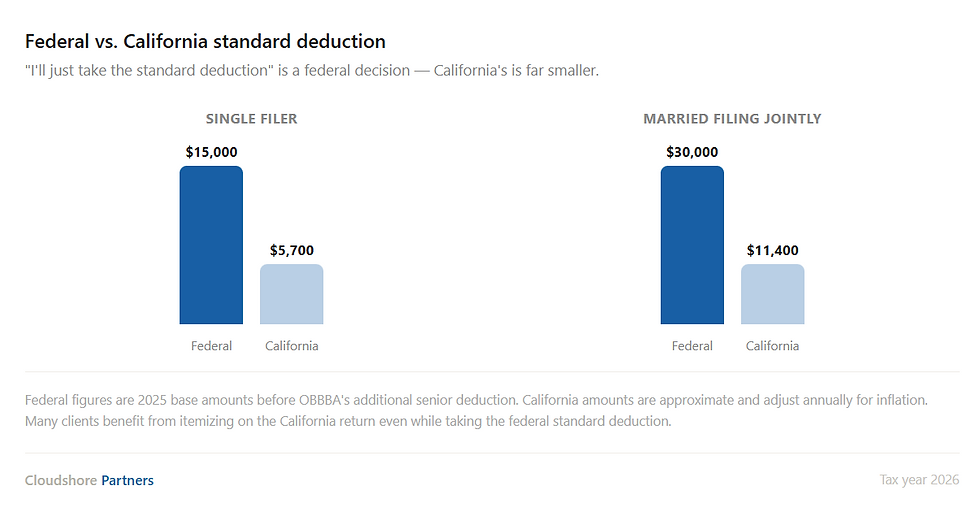
1. Standard deduction. California has its own standard deduction, and it's much smaller than the federal one. For 2025, the federal standard deduction is $15,000 (single) / $30,000 (MFJ) before OBBBA's additional senior deduction; California's is roughly $5,700 / $11,400. This gap has always existed — it's not new — but it means "I'll just take the standard deduction" is a federal decision, not a California one. Many clients benefit from itemizing on the California return even when taking the standard deduction federally.
2. No tips or overtime deduction. OBBBA created new federal deductions for qualified tips and qualified overtime pay (through 2028). Because these are OBBBA provisions, California does not conform — the income is still fully taxable at the state level even though it's deductible federally. Clients in tipped or hourly-overtime industries may have withholding assumptions that don't match their actual California liability.
3. Qualified Business Income deduction (Section 199A). This one isn't new — California has never conformed to the 20% QBI deduction since it was created in 2017. Pass-through business owners get the federal benefit and add it right back on the California return.
4. Bonus depreciation. OBBBA made 100% bonus depreciation permanent federally. California has its own, more restrictive depreciation rules and does not conform to bonus depreciation at all — assets are depreciated under California's own (generally slower) schedules. This creates a federal/state basis difference that has to be tracked separately, sometimes for years.
5. Charitable deduction changes. OBBBA introduced a 0.5%-of-AGI floor on itemized charitable deductions and a 35% deduction-value cap for top-bracket taxpayers. Since these are OBBBA provisions, California does not apply them — California computes its own charitable deduction under its own, separate itemized deduction rules.
A quick example
The Parks — a dual-income couple in Rancho Santa Margarita, combined W-2 and overtime pay, $340,000 AGI — assumed their new OBBBA overtime deduction ($9,800 of overtime pay excluded federally) would lower both returns. It lowered federal taxable income by $9,800. California taxable income: unchanged — the full $9,800 is still California-source, California-taxable wages. At their roughly 9.3% marginal California rate, that's about $910 of California tax their federal withholding change didn't anticipate.
Multiply that kind of gap across tips, overtime, bonus depreciation, and QBI, and it's easy to see why a "federal-only" mental model causes underpayment surprises — and why safe-harbor estimated payments matter even more in years with big federal changes.
The bottom line for Part 1
None of this is a reason to distrust the tax headlines — it's a reason to always ask the second question: does California conform? For 2025 and 2026 planning specifically, treat every OBBBA-driven federal change as federal-only until you've confirmed otherwise. The gap between "what changed" and "what changed for California" is exactly where most surprises — and most planning opportunities — live.


